Long before there was a website called The Coastal Buzz, before hundreds of millions of automotive video views, before hundreds of interviews, and long before his 14-year-old son sat across from the mayor of Pooler, Chris Benton fell in love with local media.
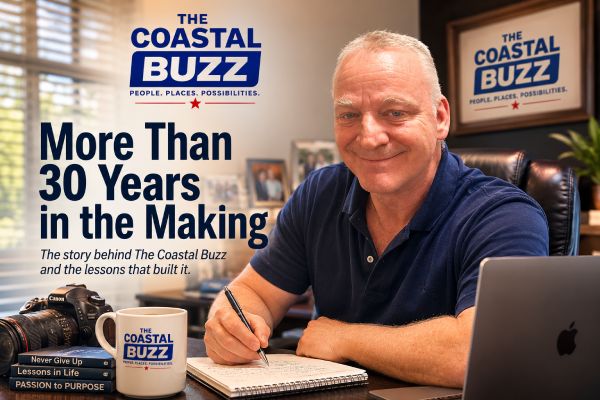
The Coastal Buzz officially came back to life on April 23, 2026. But calling that the beginning wouldn’t tell the story.
The real story reaches back more than three decades. It runs through a local business newspaper, a magazine that almost happened, a monthly newspaper that came painfully close to becoming sustainable, an early Savannah website that changed everything, years of interviewing people from the entertainment world, an automotive media company that reached millions, and a domain name purchased in 2016 that somehow remained part of the picture through all of it.
Looking back, there wasn’t one moment when The Coastal Buzz began.
There were many.
And each one left behind a lesson that would eventually be needed.
It Started With a Business Newspaper
In the 1990s, Benton went to work for a local business newspaper.
His job included selling advertising, but somewhere along the way, he fell in love with the entire idea of the publication itself.
There was something about local media that clicked — walking into businesses, meeting owners, building relationships, selling advertising and then seeing everything come together in something created specifically for the local community.
Then came word that the newspaper was being bought out.
The staff was going to be let go.
For Benton, losing something he had grown to love sparked an idea.
What if they created their own?
It was the 1990s, and Benton believed a business magazine could be even better than a newspaper. A magazine could have a longer shelf life and offer a different kind of experience for readers and advertisers.
There was only one problem.
He had never launched a magazine.
Apparently, that didn’t stop him from convincing an entire group of people who had just lost their jobs that they should try it with him.
They loved the idea.
Suddenly Benton had something that many people with a business idea spend years trying to find.
He had a team.
Now he believed he needed investors.
So he went looking for them.
Potential investors became interested, conversations took place and for a while the magazine appeared as though it might actually happen.
Then the investment fell through.
Without the money Benton believed was necessary to launch, the magazine fell through with it.
More than 30 years later, the mistake seems obvious to him.
He already knew how to sell advertising.
Instead of believing someone first had to write a large check to fund the magazine, he could have gone into the business community, sold the advertising and used those commitments to help fund the publication.
He simply didn’t understand that yet.
The magazine disappeared.
The dream of local media didn’t.
The Homesteader Gave Him Another Shot
Years later, another opportunity came along.
Benton was given the chance to operate a licensed edition of a monthly newspaper called The Homesteader, a publication created for new homeowners.
This time there was an established concept behind him. He traveled to Boston for training and returned home excited about building the local edition.
Then he started selling advertising.
And businesses responded.
The idea seemed to connect. Advertisers liked what he was offering, and the publication began going out.
But Benton made a mistake he still remembers.
He launched too soon.
Instead of waiting until enough advertising was committed to comfortably support each issue, he started publishing and used his own money to make up the difference.
Month after month, he kept going.
The advertising base grew.
The gap narrowed.
His own money continued disappearing.
Eventually, after everything he had put into it, The Homesteader reached approximately the break-even point.
It appeared that the gamble might finally work.
Then his largest advertiser pulled out.
It was a full-page account, and the decision had nothing to do with whether The Homesteader was working. The advertiser’s own business was heading toward failure and could no longer continue.
But the reason didn’t change what it meant for Benton.
He had already exhausted the money he could continue putting into the publication. Losing that account created a hole he no longer had the resources to fill.
Years earlier, the business magazine had taught him one lesson about funding a publication.
The Homesteader taught him another.
But there was something else happening at exactly the same time.
And ultimately, it made walking away from the newspaper much easier.
This Internet Thing Might Actually Work
While Benton was still operating The Homesteader, he had begun experimenting with a little local website.
He called it LocalSavannah.com.
It is easy today to look at launching a local website and see nothing particularly unusual about it. But this was a very different era of the internet.
Local digital media wasn’t yet the obvious direction it would eventually become. Benton wasn’t following a proven formula for building an online local publication.
He was experimenting.
Then LocalSavannah did something The Homesteader had struggled for months to accomplish.
It broke even in its first month.
And it started growing.
Benton suddenly had two media businesses sitting beside each other telling him two very different stories.
One required printing, physical distribution and enough advertising every month to cover those expenses. He had poured his own money into keeping it alive and had finally reached the break-even point, only to lose his largest advertiser.
The other was this new thing called a website.
And almost immediately, it was paying for itself.
The decision became much clearer.
Benton shut down The Homesteader and put his energy into LocalSavannah.com.
The internet had won.
LocalSavannah Became Something Bigger
LocalSavannah continued growing.
Eventually Benton expanded the idea with LocalPooler.com and several other local guides around the area.
For several years, he was doing something that now looks remarkably familiar.
He was building local digital properties around individual communities.
He was connecting residents with local information.
He was working with local businesses.
He was selling advertising.
And he was learning that local media didn’t necessarily need a printing press.
Eventually, life changed and Benton sold the sites to a friend.
Another chapter ended.
But by then, something had been established that would matter many years later.
Benton knew local digital media could work because he had already done it.
Technology would change dramatically. Social media would eventually transform how people discovered information. Smartphones would put the internet in nearly everyone’s pocket.
But underneath all of those changes was something Benton had already experienced firsthand:
People wanted to know what was happening around them. And local businesses wanted ways to reach those people.
Then Came 2016
Years later, the idea surfaced again.
On June 2, 2016, Benton registered a domain name:
TheCoastalBuzz.com.
The Coastal Buzz was originally launched that year, but it wasn’t yet the publication it would eventually become.
The pieces weren’t all there.
Life moved in other directions. Other projects demanded attention. The Coastal Buzz eventually went quiet.
But Benton never completely let it go.
He kept the domain.
At the time, there was no way to know that a seemingly dormant website would eventually become the place where decades of seemingly disconnected experiences would come together.
Because Benton still had a few more things to learn.
Hundreds of Conversations Changed the Way He Saw Stories
One of those lessons came through The Chris & Sandy Show.
Chris and his wife, Sandy, spent years interviewing people from the entertainment industry, eventually conducting hundreds of conversations with artists, actors and other personalities.
Those interviews taught Benton something advertising never could.
They taught him to listen.
A person’s occupation might get them into the interview, but it wasn’t necessarily the most interesting thing about them.
Sometimes the story was buried inside an unexpected answer. Sometimes it appeared when the prepared questions stopped mattering. Sometimes the person behind the public image was far more interesting than the image itself.
Over hundreds of interviews, the Bentons learned how to have conversations with people.
That experience would eventually become part of The Coastal Buzz.
But before Benton returned to local media, another unexpected chapter began.
This one had four wheels.
A Father, A Son and Hundreds of Millions of Views
In October 2022, Chris and his son, Christopher — better known around the family’s media brands as Lil Chris — launched The Customized Ride.
The idea grew far beyond what either of them initially imagined.
Along with other family automotive brands including Hot Classic Rides and Heavy Load Trucks, their content eventually accumulated hundreds of thousands of followers and hundreds of millions of video views.
The family learned another side of modern media.
They learned short-form video. They learned social platforms. They learned what makes someone stop scrolling. They traveled to automotive events, interviewed owners and builders, photographed vehicles and built relationships throughout car culture.
For someone who had once wondered whether he could create a local business magazine, Benton now had undeniable proof that his family could build an audience.
A very large one.
But success brought another lesson.
A huge audience and a sustainable media business aren’t necessarily the same thing.
Social platforms can provide incredible reach, but the creator doesn’t own them.
Algorithms change.
Reach changes.
Monetization changes.
Platforms change what they prioritize.
Years of work can build an enormous following on digital property ultimately controlled by someone else.
The Customized Ride taught Benton that attention mattered.
It also reminded him that ownership mattered.
And sitting there through all of it was a domain name he had registered years earlier.
April 23, 2026
On April 23, 2026, The Coastal Buzz officially came back.
Except this time, the man building it wasn’t really starting from scratch.
He was carrying more than 30 years of lessons with him.
He had worked for a business newspaper and fallen in love with local media.
He had assembled a team around a business magazine that never got funded.
He had learned that sometimes you don’t need to wait for investors — you need to sell.
He had launched a newspaper before enough revenue was there to comfortably sustain it and learned what happens when expenses get ahead of income.
He had watched one lost advertiser help end a publication just as it reached break-even.
He had launched a local website that broke even in its first month.
He had expanded that website into multiple local guides.
He had conducted hundreds of interviews.
He had helped build media brands responsible for hundreds of millions of views.
And scattered between those chapters were more business ideas, successes, failures and lessons than he could easily count.
This version of The Coastal Buzz was being built by someone carrying all of them.
Finding the Lane
The Coastal Buzz would focus on the people, places and possibilities shaping the Savannah area and surrounding communities.
But Benton didn’t simply want another local news website.
He wanted to make a deliberate choice about what kind of media company his family would put into the community.
No chasing crime for clicks.
No political fighting.
No building an audience around neighbors being angry with one another.
No outrage simply because outrage generates engagement.
Instead, Benton began describing the philosophy behind The Coastal Buzz as Possibility Journalism.
That doesn’t mean pretending communities don’t have problems.
It means recognizing that problems aren’t the only stories communities have.
Businesses are opening. Jobs are being created. Entrepreneurs are taking risks. Nonprofits are changing lives. Teachers and coaches are pouring years into children. First responders have stories behind their uniforms. Young people are accomplishing remarkable things. Communities are growing and changing.
And some people spend decades quietly making their corner of the world better without anybody ever stopping to ask them about it.
The Coastal Buzz wants to notice those people.
Sometimes the question behind a story can be remarkably simple:
Who is doing something worth knowing about that everyone else keeps walking past?
The Business Lessons Came With Him Too
The Coastal Buzz isn’t being built with the assumption that revenue can be figured out someday after the audience becomes big enough.
Benton has already lived that mistake in different forms.
This time, the business model is being developed alongside the editorial product.
Buzz Partners create long-term relationships with businesses and organizations. Advertising creates opportunities for companies to support local storytelling. Sponsorships can eventually support recurring editorial series. Events and other ideas can add additional revenue.
And the website remains at the center.
Social media is enormously valuable for distributing stories, but the goal is to bring people back to something the family owns.
TheCoastalBuzz.com.
There is something almost poetic about that.
In the 1990s, Benton thought he needed investors before he could launch a magazine.
With The Homesteader, he learned what happens when you launch before enough advertising supports the expenses.
LocalSavannah showed him how dramatically digital media could change those economics.
The Customized Ride showed him the incredible power of social media — and the vulnerability that comes from depending too heavily on platforms you don’t own.
Now all of those lessons are sitting inside the same business.
Then It Became About the Kids
Something happened after the 2026 reboot that Benton didn’t fully anticipate.
The Coastal Buzz started looking like more than a business.
It started looking like an opportunity for the Benton children.
For a homeschooling family, the publication could become part classroom, part leadership laboratory and part real-world experience.
Christopher’s involvement with Trail Life USA already provides opportunities centered around character, citizenship, service and leadership. His younger sister Katelynn is developing through American Heritage Girls.
The Coastal Buzz gives them another place to put some of those principles into practice.
Not through an exercise.
In the real world.
The First Interview
In August 2026, 14-year-old Christopher officially stepped into his role leading Youth Buzz, a section of The Coastal Buzz focused on young people and their stories.
His first interview wasn’t conducted from the family living room.
He walked into Pooler City Hall and sat down with Mayor Karen Williams.
The topic was fitting: Pooler’s first Youth Council and the importance of young people having a voice in their community.
For Chris and Sandy, watching their son conduct that interview represented something much larger than producing another piece of content.
More than 30 years earlier, a young Chris Benton had been selling advertisements for a business newspaper and dreaming about building a publication.
Now his 14-year-old son was sitting across from a mayor representing the family’s own media company.
After the interview, another door opened.
When Chris and Sandy explained Christopher’s vision of interviewing young people doing great things, Williams suggested that once Pooler’s Youth Council gets established, Christopher could return and interview some of its members.
One conversation created the possibility for another.
That’s exactly the kind of education his parents hope The Coastal Buzz can provide.
Building Leaders, Not Just Content Creators
Chris and Sandy aren’t trying to turn their children into social-media personalities.
Their goal is much larger.
They want to help develop local leaders — and give their children skills that can carry them far beyond the Savannah area if that’s where life eventually takes them.
How do you walk into a room and introduce yourself?
How do you speak confidently with a mayor?
How do you interview a business owner?
How do you ask a thoughtful question and then actually listen to the answer?
How do you communicate with someone twice or three times your age?
How do you treat the person nobody recognizes with the same respect you give the person everybody recognizes?
How do you research?
How do you tell someone else’s story responsibly?
How do you serve?
How do you lead?
Those aren’t simply media skills.
They’re life skills.
And the Benton children will ultimately decide what they do with them.
Then Comes Katelynn
Christopher, if he chooses, can continue building Youth Buzz through his teenage years and into young adulthood.
The family’s hope is that he will lead it until around age 20.
By then, his little sister will be 13.
And if she chooses, Christopher can hand what he helped build to Katelynn.
Not so she can become a copy of her brother.
Quite the opposite.
The hope is that he hands her the foundation and she decides what to build on it.
Katelynn won’t have to wait until 13 to begin learning.
Next year, she is expected to begin doing age-appropriate things through Kidz Buzz, another part of The Coastal Buzz. She can grow into interviewing and storytelling gradually while watching what her brother is doing several years ahead of her.
Eventually, brother can teach sister.
And sister can make it hers.
Maybe Someday, It Won’t Be a Benton
That’s where the vision gets even more interesting.
By the time Katelynn eventually grows beyond Youth Buzz, The Coastal Buzz could have more than a decade of experience teaching young people how to interview, research, create media and interact with their community.
At that point, why stop?
Perhaps a local teenager applies each year to become a Youth Buzz correspondent or intern.
That young person spends a year learning interviewing, writing, video, community engagement and leadership inside an actual local media organization.
At the end of the year, that teenager helps prepare the next one.
Something created to give the Benton children opportunities could eventually give opportunities to young people the family hasn’t even met yet.
That would be quite a journey for something that started with a young advertising salesman wondering whether he could create a magazine.
Maybe None of It Was Wasted
It would be easy to clean this story up.
Remove the magazine that never happened.
Skip the investors who fell through.
Leave out the money lost publishing The Homesteader.
Jump over the businesses and ideas that didn’t last.
Move directly from working at a newspaper to launching The Coastal Buzz and make the whole thing appear as though someone planned it.
That’s not what happened.
And maybe that’s the most important part of the story.
The business newspaper sparked something.
The magazine taught Benton that waiting for somebody else to fund an idea could kill it before it started.
The Homesteader taught him the danger of launching before revenue was ready to carry the expenses.
LocalSavannah taught him that digital local media could work — and proved it by breaking even its very first month.
The local guides taught him about serving individual communities online.
The Chris & Sandy Show taught him to look beyond someone’s title and find the person underneath.
The Customized Ride taught the family how to build enormous audiences while also showing them the limitations of building primarily on platforms somebody else owns.
Even the projects that ended left something behind.
And now The Coastal Buzz gets all of those lessons.
More Than 30 Years in the Making
The Coastal Buzz is still young in its current form.
There is no guarantee about where this story goes next.
Benton understands that better today than he did when he was in his twenties.
A good idea still has to become a good business.
Advertising still has to be sold. Partners still have to see value. Readers still have to show up. Revenue has to exceed expenses. Relationships have to be earned. Trust has to be protected.
There will undoubtedly be things that work and things that don’t.
The difference is that Benton isn’t walking into those lessons for the first time anymore.
He’s carrying more than three decades of them.
And this time, Sandy is beside him. Christopher is beginning to create his own chapter. Katelynn will soon begin hers.
Maybe someday the kids take over pieces of what their parents built.
Maybe they don’t.
Maybe the greatest thing The Coastal Buzz ultimately gives them isn’t a company at all, but the confidence, relationships, leadership experience and opportunity to go build something of their own.
That’s their decision to make.
Chris and Sandy’s job is to build the runway.
And perhaps that’s why this version of The Coastal Buzz feels different.
It’s no longer simply about whether Chris Benton can finally build the local media company he first imagined decades ago.
It’s about building something rooted in the place his family calls home. Something that helps neighbors discover one another. Something that gives businesses a platform. Something that preserves stories that might otherwise disappear. Something that creates opportunities for his children — and perhaps eventually for other people’s children too.
The technology has changed.
Newspaper became magazine idea.
Print became websites.
Websites became social media.
Social media led back to an owned local publication.
But underneath all of it, the idea has remained remarkably similar.
Local people. Local businesses. Local relationships. Local stories.
So maybe The Coastal Buzz didn’t really begin when it was rebooted on April 23, 2026.
Maybe it didn’t begin when TheCoastalBuzz.com was registered in 2016.
Maybe it began more than 30 years ago, when a young advertising salesman fell in love with a little local business newspaper and had a thought he couldn’t quite shake:
What if I could build something like this?
It just took a few decades to discover what that “something” was supposed to become.
The editorial team behind The Coastal Buzz, spotlighting the People, Places & Possibilities shaping Metro Savannah, the Coastal Empire & Lowcountry. Founded by Chris & Sandy Benton.