Across the country, many local news feeds have become dominated by outrage, fear, division, and exhaustion. But a growing movement toward possibility journalism is asking a different question: what if communities also need stories that help people believe in where they live again?
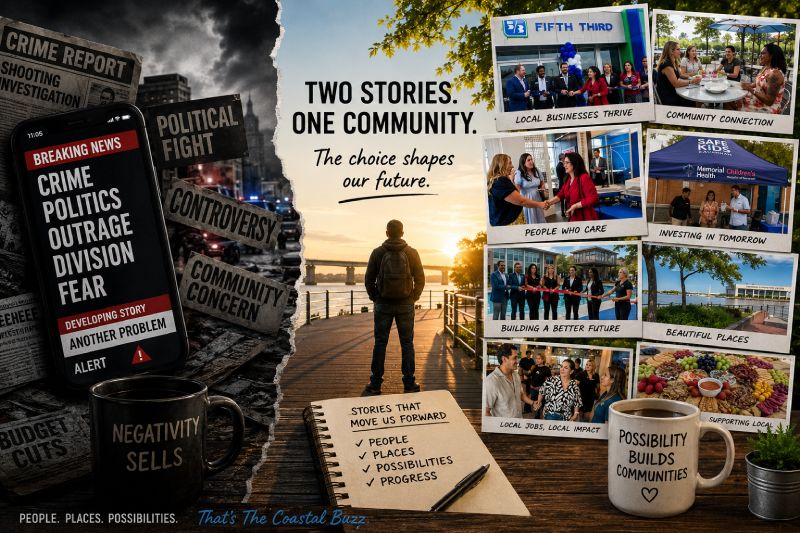
Scroll through enough local news feeds today and a pattern begins to emerge.
Crime alerts.
Political fights.
Public outrage.
Fear-driven headlines.
Conflict packaged for clicks.
Communities introduced to themselves primarily through what is broken.
Over time, something subtle starts happening to people.
Not just emotionally, but psychologically.
Communities begin absorbing the belief that decline is the dominant story around them. Residents become more cynical. Trust erodes. Hope narrows. People slowly stop seeing possibility in the places they live because the stories surrounding them rarely leave room for it.
That does not mean problems are not real.
They are.
Every city faces challenges worth discussing honestly and responsibly. Journalism matters because accountability matters. Truth matters. Public awareness matters.
But somewhere along the way, much of modern media drifted toward a model where problems became the product itself.
And when that happens long enough, communities can begin feeling emotionally disconnected from themselves.
That is part of why possibility journalism matters.
And it is part of why The Coastal Buzz was built differently.
The Difference Between Problem Journalism and Possibility Journalism
Problem journalism focuses primarily on what is wrong.
Possibility journalism asks what is still being built.
The distinction is not about ignoring reality or pretending hard things do not exist. It is about broadening the picture of what communities actually are.
A city is not only its crime reports.
A region is not only its political arguments.
A community is not only its failures.
It is also:
- the small business owner opening a second location
- the nonprofit helping families quietly every week
- the student filmmaker finding confidence for the first time
- the restaurant creating gathering spaces for neighbors
- the young entrepreneur taking a risk
- the volunteers rebuilding something damaged
- the teacher changing lives nobody else notices
These stories exist every day.
They simply do not always generate outrage metrics.
That is where modern media economics changed the landscape.
According to research from the Reuters Institute for the Study of Journalism and the American Psychological Association, audiences increasingly report feeling emotionally exhausted by news consumption, with many intentionally avoiding news altogether because of stress, negativity, and burnout tied to constant crisis-driven coverage.
In other words, many people are not disconnecting because they no longer care about their communities.
They are disconnecting because they no longer recognize their communities in the coverage.
The Emotional Health of a Community Matters Too
Communities are shaped not only by infrastructure and economics, but by narrative.
The stories people repeatedly hear about where they live begin shaping:
- civic pride
- local optimism
- business confidence
- emotional connection
- regional identity
- even whether young people can imagine a future there
That does not mean journalism should become propaganda or blind positivity.
Authentic possibility journalism is not about pretending everything is perfect.
It is about refusing to believe negativity is the only meaningful lens through which a community can be viewed.
In regions like the Coastal Empire and Lowcountry, this distinction feels especially important right now.
These communities are changing rapidly.
New residents are arriving.
Businesses are expanding.
Young entrepreneurs are building.
Creative industries are growing.
Families are planting roots.
Neighborhoods are evolving.
Yet if someone only consumed the most outrage-driven version of local media, they might never realize how much hope, creativity, and momentum also exist underneath the surface.
That imbalance has consequences.
Because people invest in places they believe in.
Why The Coastal Buzz Chose a Different Direction
The Coastal Buzz was never created to compete in the race for the darkest headline.
It was created around a different belief:
People. Places. Possibilities.
That philosophy shapes the stories we choose to cover.
Not because difficult realities should be ignored, but because communities also deserve coverage that reflects what is working, what is growing, and what is still worth believing in.
A ribbon cutting may seem small to some outlets.
But to the business owner risking everything to open those doors, it is life-changing.
A student arts festival may not dominate national headlines.
But for the young creative discovering confidence for the first time, it matters deeply.
A nonprofit event may not generate controversy.
But for the families receiving help, support, or hope, it becomes part of the emotional foundation of the community itself.
These stories matter.
Not as filler content.
As identity-shaping stories.
One example of this difference recently played out during coverage of Savannah’s Small Business Week kickoff event.
Multiple outlets covered the same gathering. The same ribbon cutting. The same speakers. The same business community standing together in the same physical space.
But the stories that emerged afterward felt completely different.
Some coverage leaned heavily into the struggles facing small businesses, rising costs, uncertainty, operational pressure, and economic anxiety. Those challenges are real, and they deserve acknowledgment. But often, the direction of a story is shaped by the direction of the questions being asked.
At The Coastal Buzz, we found ourselves drawn toward something else happening.
The handshakes between business owners and city leaders.
The conversations happening under the trees in Johnson Square.
The entrepreneurs still choosing to bet on this region despite the risks.
The visible energy around collaboration, momentum, and community-building.
We walked away seeing a story not centered on fear, but on movement.
Not because challenges do not exist, but because possibility existed in that space too.
That moment reinforced something important for us: journalism does not just document communities. It frames how communities see themselves. Two outlets can attend the exact same event and leave telling entirely different emotional stories about the future of a city.
One story can leave readers feeling defeated.
Another can leave readers believing there is still something worth building together.
That distinction matters more than many people realize.
There Is Something Bigger Happening Here
Across the country, many people are quietly searching for healthier ways to stay connected to their communities without feeling emotionally drained every time they open an app.
That does not mean abandoning journalism.
It may mean expanding it.
Some media organizations have started calling this constructive journalism or solutions journalism. Others describe it as community-centered reporting or civic storytelling.
Whatever label gets attached to it, the deeper idea is similar:
Communities need honest reporting, but they also need perspective, context, humanity, and hope.
Especially now.
Because fear may capture attention quickly, but possibility builds long-term connection.
And connection is what healthy communities ultimately depend on.
The Buzz Take
At The Coastal Buzz, we believe local media should help people feel more connected to where they live, not emotionally defeated by it.
That does not mean ignoring challenges.
It means recognizing that communities are more than their worst moments.
The Coastal Empire and Lowcountry are filled with builders, dreamers, volunteers, creators, educators, entrepreneurs, families, and everyday people trying to make this region better in quiet ways most algorithms will never prioritize.
We believe those stories deserve visibility too.
Because the stories communities repeatedly hear about themselves eventually shape what those communities believe they can become.
And maybe one of the most important questions local media can ask moving forward is this:
What happens when people start believing in their communities again?
The editorial team behind The Coastal Buzz, spotlighting the People, Places & Possibilities shaping Metro Savannah, the Coastal Empire & Lowcountry. Founded by Chris & Sandy Benton.