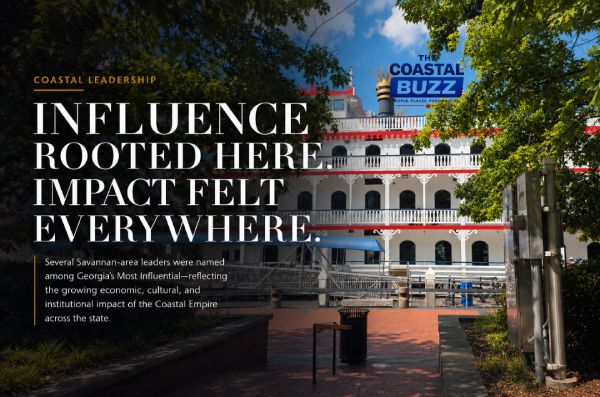
From ports and preservation to education and economic growth, Savannah leaders continue shaping conversations far beyond city limits.
Every year, Georgia’s political and business circles pause to study one particular list.
Not because it’s flashy.
Not because it trends online.
But because it quietly reveals who is actually helping shape the direction of the state.
JAMES Magazine’s annual “100 Most Influential Georgians” issue has long been considered one of Georgia’s most closely watched recognitions of leadership across business, politics, education, media, law, and public service. And this year, Savannah’s footprint across that list feels impossible to ignore.
From global commerce and aviation growth to education, preservation, economic development, and public leadership, several names connected to the Savannah region were recognized among the state’s most influential voices.
Leading the way was Georgia Ports Authority President and CEO Griff Lynch, who was named “Georgian of the Year” by the publication.
Other Savannah-connected leaders recognized included Steve Green of the Savannah Airport Commission, Todd Groce of the Georgia Historical Society, U.S. Attorney Meg Heap, Jepson Associates Chairman Robert Jepson, SCAD President Paula Wallace, and Savannah Economic Development Authority President and CEO Trip Tollison.
On the surface, it reads like a list of accomplished people.
But underneath it may be something more significant.
It may be a snapshot of what Savannah is becoming.
A City Increasingly Influencing the State Around It
For decades, Savannah was often viewed as a beautiful historic city with tourism appeal, deep culture, and coastal charm.
Today, it is increasingly becoming something else too.
An economic engine.
A logistics powerhouse.
An education hub.
A fast-growing innovation corridor.
A city whose influence now stretches well beyond the region itself.
You can see that transformation through many of the leaders recognized this year.
Griff Lynch’s recognition comes during a period of extraordinary growth for the Georgia Ports Authority and the Port of Savannah, which has become one of the most important economic drivers in the Southeast. According to the Georgia Ports Authority and research from the University of Georgia’s Terry College of Business, Georgia’s ports now support more than 650,000 jobs statewide and generate approximately $174 billion in annual sales impact across Georgia’s economy.
The Port of Savannah has also emerged as one of the fastest-growing container ports in the country, with Georgia Ports officials noting Savannah was the fastest-growing major port on the East and Gulf coasts during 2024.
But statistics alone do not fully explain why this matters locally.
What happens at the port increasingly shapes what happens across the entire region.
Warehousing.
Manufacturing.
Transportation.
Construction.
Small business growth.
Population shifts.
Housing demand.
Restaurant expansion.
Infrastructure conversations.
Career opportunities.
Much of the region’s momentum is directly or indirectly tied to the economic gravity being created around Savannah.
And yet, this year’s list also reflects something equally important:
Savannah’s influence is no longer coming from one lane alone.
Preservation, Education, and Identity Still Matter Here
While economic headlines often dominate public conversation, some of the most important names on this year’s list reflect institutions focused on preserving culture, shaping identity, and investing in long-term community influence.
Todd Groce and the Georgia Historical Society continue helping position Savannah as one of the South’s leading centers for historical scholarship and civic preservation.
Paula Wallace and Savannah College of Art and Design have spent years transforming not only higher education, but Savannah’s international creative reputation. SCAD’s impact stretches far beyond classrooms. The university has helped reshape downtown development, entrepreneurship, design culture, film visibility, tourism, and creative industry recruitment throughout the region.
In many ways, Savannah’s national identity today is partly tied to the creative ecosystem SCAD helped cultivate over decades.
Meanwhile, leaders like Steve Green and Trip Tollison represent another side of the region’s evolution: infrastructure and economic positioning.
Savannah/Hilton Head International Airport continues seeing major passenger growth while the Savannah Economic Development Authority remains deeply involved in recruiting industry, investment, and long-term expansion into the Coastal Empire.
Together, these recognitions tell a broader story that feels bigger than individual achievement.
This is not simply about successful people from Savannah being honored.
It is about Savannah increasingly sitting at the table where Georgia’s future is being shaped.
The Hidden Story Inside the List
Sometimes recognition lists reveal more about a place than they do about the people on them.
And one of the more interesting realities here is that many of these leaders operate in entirely different worlds.
Ports.
Higher education.
History.
Economic development.
Federal law.
Aviation.
Private investment.
Yet all of them, in different ways, are connected to the same larger regional story:
Savannah is no longer viewed as a secondary Georgia market.
The city and surrounding Coastal Empire region are increasingly becoming central to the state’s economic and cultural identity.
That shift has happened quietly over time.
Not through one defining moment.
Not through one giant announcement.
But through years of infrastructure investment, institutional leadership, population growth, business recruitment, educational expansion, and cultural development steadily layering on top of each other.
And now, those layers are becoming harder to ignore statewide.
The Buzz Take
One of the most encouraging parts of this year’s recognition is the diversity of influence represented.
This was not just a list dominated by politics.
It reflected leadership through commerce, education, preservation, creativity, economic vision, and institutional stewardship.
That matters.
Because the healthiest regions are usually not built by one industry or one personality alone. They are built through ecosystems of people working in different lanes while collectively pushing a region forward.
Savannah’s story right now feels increasingly connected to that idea.
A port city becoming an innovation city.
A tourism city becoming a business city.
A historic city becoming a future-focused city without completely losing its identity along the way.
And maybe that is the deeper story hiding underneath this year’s list.
Not simply who made it.
But what their presence says about where this region may be headed next.
The editorial team behind The Coastal Buzz, spotlighting the People, Places & Possibilities shaping Metro Savannah, the Coastal Empire & Lowcountry. Founded by Chris & Sandy Benton.